


Executive Summary: Safeguarding Commercial Assets Across Austin, Texas
Operating a business in Austin, Texas—from retail shops along South Congress and high-tech campuses in North Austin to warehouses in East Austin and corporate offices downtown—requires proactive physical security. Protecting commercial properties against theft, inventory shrinkage, vandalism, and unauthorized intrusion is critical for maintaining operational continuity, protecting employees, and safeguarding profit margins.
A commercial alarm system serves as the primary line of physical defense for modern enterprises. Unlike basic unmonitored security setups, enterprise security infrastructure unifies real-time intrusion sensors, cloud access control, high-definition IP video surveillance, and 24/7 UL-listed central station monitoring into a single managed network.
Dyezz Surveillance and Security delivers turn-key commercial security system design, installation, maintenance, and monitoring across Central Texas. Fully licensed under Texas State Fire and Security regulations (License #ACR-2713), Dyezz builds customized security solutions tailored to Austin’s unique commercial environments.
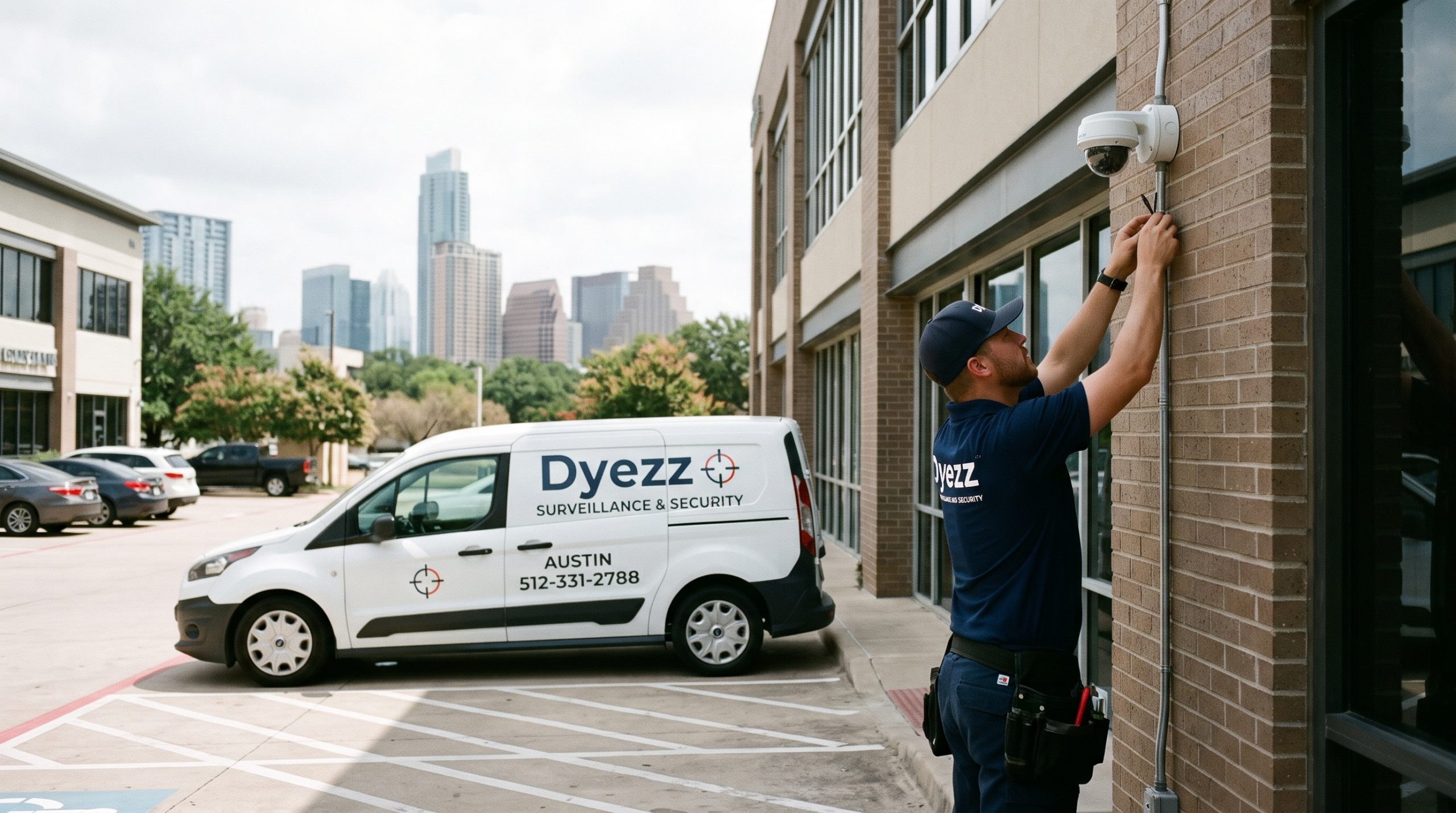
Core Components of a Modern Texas Commercial Security System
A commercial alarm system relies on interconnected hardware and software components working in harmony to detect, report, and neutralize physical security threats.
┌────────────────────────────────────────────────────────────────────────┐
│               Centralized Commercial Control Panel Hub                 │
└───────────────────────────────────┬────────────────────────────────────┘
                                    │
         ┌──────────────────────────┼──────────────────────────┐
         │                          │                          │
┌────────┴─────────┐       ┌────────┴─────────┐       ┌────────┴─────────┐
│ Intrusion Sensors│       │ Access Control   │       │ IP Surveillance  │
│ (Door/Motion/Glass)     │ (Keycards/Mobile)│       │ (AI Deterrence)  │
└──────────────────┘       └──────────────────┘       └──────────────────┘
1. Intrusion Detection Sensors
-
Magnetic Door & Window Contacts: Heavy-duty aluminum surface-mount contacts monitor external entry doors, overhead roll-up warehouse doors, and emergency exit hatches.
-
Passive Infrared (PIR) & Dual-Tech Motion Detectors: Detect human heat signatures and physical movement within interior spaces, ignoring HVAC airflow or minor environmental disruptions.
-
Acoustic Glass-Break Sensors: Monitor high-frequency sound frequencies associated with breaking glass along storefront windows and glass office partitions up to 25 feet away.
2. Commercial Access Control Systems
Electronic access control regulates employee movements, secures sensitive zones (such as IT server rooms, pharmacy inventory, or cash-handling areas), and eliminates physical metal keys. Utilizing high-frequency 13.56 MHz smart cards (MIFARE DESFire EV2/EV3) or Touchless Mobile Credentials (via Openpath, Swiftlane, or Salto), administrators can manage user permissions remotely and track time-stamped entry logs.
3. Integrated 4K IP Surveillance Cameras
High-definition IP video cameras provide continuous visual verification across commercial perimeters, cash registers, and loading bays. Equipped with Power over Ethernet (PoE) cabling, Wide Dynamic Range (WDR) sensors, and edge AI analytics, modern surveillance cameras identify humans and vehicles in real time, triggering strobe lights and voice warnings before break-ins occur.
4. 24/7 Central Station Monitoring & Cellular Communicators
When an intrusion sensor trips, the alarm panel transmits an immediate alert over encrypted dual-path cellular/IP communicators (bypassing legacy copper landlines) to our 24/7 UL-Listed Central Station. Trained dispatchers verify the alert and dispatch Austin Police Department (APD) or Travis County Sheriff officers in under 3 seconds.
Comparing Unmonitored Alarms vs. Professionally Monitored Commercial Systems
Choosing between a basic standalone alarm and a professionally monitored commercial security network directly impacts emergency response speeds and insurance rates.
| Security System Feature | Standalone / Unmonitored Alarm | Dyezz Monitored Commercial Alarm |
| Emergency Signal Transmission | Local audible siren only | Dual-Path Encrypted Cellular & IP Signal |
| Emergency Dispatch Speed | Relies on bystanders or staff calling 911 | Automatic UL Central Station Dispatch (<3 Secs) |
| Mobile Remote Control | Limited or non-existent | Full Remote App Control (Arm/Disarm/Status) |
| Video & Access Control Sync | Disconnected hardware components | Unified IP Video, Access Control & Alarm Hub |
| Commercial Insurance Discount | Ineligible for major policy discounts | Qualifies for 5% to 20% Commercial Premium Reduction |
| False Alarm Verification | High risk of municipal fines | Video & Audio Verification Prior to Dispatch |
Industry-Specific Alarm Solutions for Austin Commercial Verticals
Different business sectors across Austin face distinct security threats and operational challenges:
+------------------------------------+------------------------------------+------------------------------------+
| Austin Commercial Sector           | Primary Threat & Vulnerability     | Recommended Security Architecture  |
+------------------------------------+------------------------------------+------------------------------------+
| Retail & Shopping Centers          | Shoplifting, Vandalism, After-Hours| Glass-Break Sensors, 4K Domes,     |
| (Domain / South Congress)          | Intrusion                          | Silent Panic Buttons & Alarm Hub   |
| Corporate Tech Offices             | Unauthorized Entry, Data Theft,    | Cloud Mobile Access, Intercoms &   |
| (North Austin / Downtown)          | Vendor Tracking                    | Partitioned Alarm Zones            |
| Industrial & Warehouses            | Perimeter Cargo Theft, Wire Theft, | Heavy-Duty Door Contacts, AI       |
| (East Austin / Burleson Rd)        | Staging Yard Trespass              | Thermal Cameras & Gate Operators   |
| Restaurants & Bar Venues           | POS Theft, Cash Handling Claims,   | Motion Sensors, Heat Detectors &   |
| (Rainey St / 6th St Corridor)      | After-Hours Break-Ins              | Dual-Path Cellular Alarm Panel     |
+------------------------------------+------------------------------------+------------------------------------+
Best Practices for Commercial Alarm System Optimization
To maximize the return on investment (ROI) of a commercial alarm system and ensure long-term reliability, facility managers should adhere to the following security protocols:
-
Conduct a Comprehensive Risk Assessment: Evaluate physical vulnerabilities, entry points, lighting levels, and high-value asset locations prior to installation.
-
Implement Dual-Path Communications: Upgrade alarm communicators to dual-path LTE/5G cellular radios to prevent outages caused by cut internet or telephone lines.
-
Train Employees on Alarm Protocols: Establish clear arming/disarming procedures, unique user PIN codes, and proper panic button usage to prevent accidental false alarm dispatches.
-
Schedule Semi-Annual System Maintenance: Test battery backups, clean motion detector lenses, inspect door contact alignment, and update system firmware regularly.
-
Integrate Intrusion with Life Safety & Access: Connect intrusion alarm panels directly with commercial access control locks and NFPA-compliant fire alarm systems for automated emergency unlocking during fire events.
Navigating Austin Municipal Alarm Permits & False Alarm Regulations
Operating a commercial security alarm in the City of Austin or Travis County requires compliance with local municipal ordinances.
1. Mandatory Commercial Alarm Permits
The City of Austin mandates that all commercial property owners obtain an active commercial alarm permit through the Austin Police Department Alarm Administration. Operating an unpermitted alarm system leads to severe financial penalties whenever emergency services are dispatched to the facility.
2. Reducing False Alarm Penalties
To prevent unverified alarm calls from straining local emergency services, Austin enforces escalating fines for repeat false alarms. Dyezz mitigates false alarm risks by deploying Video-Verified Intrusion Systems. When a sensor trips, central station operators review live camera feeds to confirm human or vehicle trespass before notifying police dispatch, ensuring top-priority emergency response.
Frequently Asked Questions
1. Does the City of Austin require a permit for commercial security alarms?
Yes. The City of Austin requires commercial business owners to register their security alarm systems with the Austin Police Department Alarm Administration prior to operation.
2. How much does a commercial alarm system cost to install in Austin, TX?
Installation costs vary based on square footage, building layout, sensor count, and system complexity. Typical small business installations range from $1,200 to $3,500+, while large multi-building enterprise systems are custom-quoted.
3. What is the difference between residential and commercial alarm systems?
Commercial alarm systems utilize heavier Grade-1 hardware, support multi-partition zoning, integrate with enterprise access control and fire panels, and meet strict commercial insurance requirements.
4. Can I monitor my Austin business security alarm remotely from my phone?
Yes. Modern commercial alarm systems feature mobile apps (iOS and Android) that allow facility managers to arm/disarm panels, review audit logs, manage user codes, and receive push notifications from anywhere.
5. What happens if a burglar cuts the internet or power lines to my business?
Dyezz commercial alarm systems include battery backup power supplies and dual-path cellular communicators (LTE/5G) that transmit alarm signals wirelessly even if power or internet lines are severed.
6. Can a commercial security alarm system lower my business insurance premiums?
Yes. Major insurance carriers offer policy discounts ranging from 5% to 20% for commercial properties protected by professionally monitored security and fire systems.
7. What state licensing is required for security companies in Austin, TX?
Security integrators in Texas must be licensed by the Texas Department of Public Safety Private Security Bureau and the Texas State Fire Marshal’s Office. Dyezz operates under state license #ACR-2713.
8. How do glass-break sensors work in commercial retail storefronts?
Acoustic glass-break sensors listen for the specific dual-frequency sound pattern of shattering glass (flex wave followed by high-frequency break), covering large glass storefronts within a 25-foot radius.
9. How do panic buttons work for commercial employee protection?
Silent or audible panic buttons can be installed at reception desks, cash registers, or mobile keyfobs. Pressing the button immediately signals 24/7 central station operators to dispatch police without alerting intruders.
10. How quickly does central station monitoring dispatch emergency services?
Upon receiving an alarm signal, certified operators at our 24/7 UL-Listed Central Station verify the alert and initiate emergency dispatch to local police or fire departments in under 3 seconds.
Protect your Austin commercial facility, eliminate security blind spots, and ensure 24/7 peace of mind with integrated systems from Dyezz Surveillance and Security.
-
Schedule Your Free Commercial Security Survey: Dyezz Commercial Security Solutions
-
Call Our Austin Engineering Team: 512-331-2788
-
Explore Related Security Solutions: See our Commercial Access Control Systems, 4K Video Surveillance Installation, and 24-Hour UL Security Monitoring.
-
Licensed Texas Security Integrator: License #ACR-2713 (Austin Headquarters)