


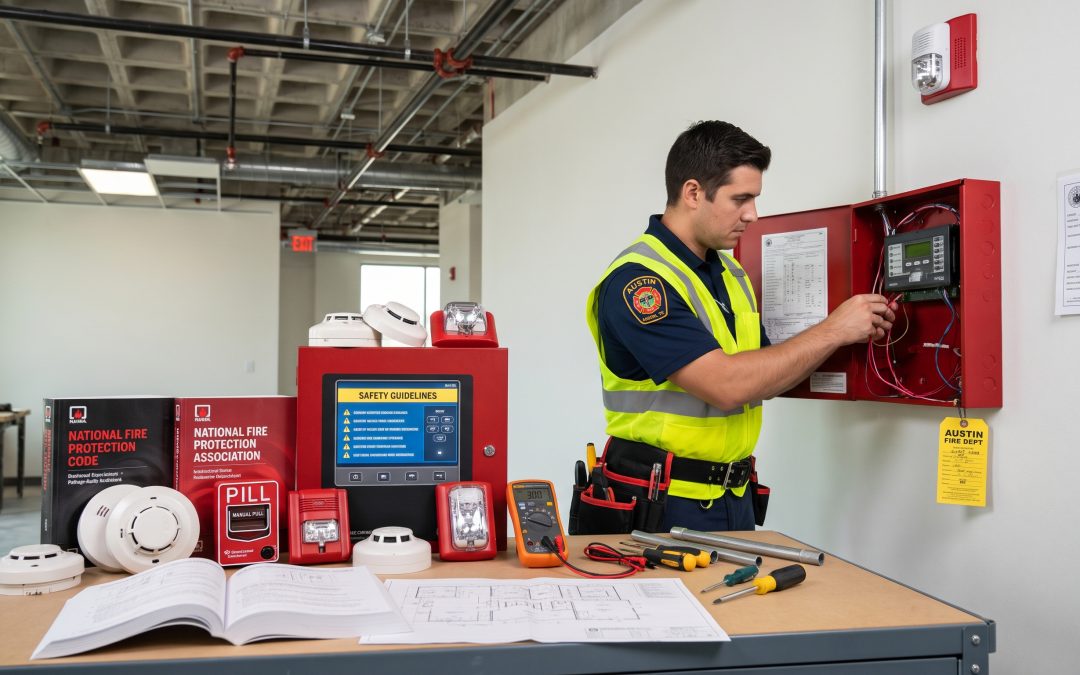
Executive Summary: Commercial Fire Safety & Municipal Compliance in Austin
Fire safety is a vital operational requirement for business owners, property managers, and facility administrators across Austin, Texas. Installing an engineered, code-compliant commercial fire alarm system significantly reduces the risk of property destruction, business disruption, and loss of life during a fire emergency.
In Central Texas, commercial fire safety requires strict compliance with regulations enforced by the Austin Fire Department (AFD) Life Safety Bureau, the Texas State Fire Marshal’s Office, and National Fire Protection Association (NFPA) standards. This comprehensive guide outlines commercial fire alarm architecture, state licensing, municipal permitting, maintenance testing protocols, and community safety resources available across Greater Austin.
Types of Fire Detection & Commercial Alarm Systems
Selecting proper initiating and notification hardware based on building layout, occupancy classification, and ambient environmental conditions is essential for early combustion warning.
┌────────────────────────────────────────────────────────────────────────┐
│               Central Fire Alarm Control Panel (FACP)                 │
└───────────────────────────────────┬────────────────────────────────────┘
                                    │
         ┌──────────────────────────┼──────────────────────────┐
         │                          │                          │
┌────────┴─────────┐       ┌────────┴─────────┐       ┌────────┴─────────┐
│ Initiating Devices│       │ Notification     │       │ Emergency Control│
│ (Smoke/Heat/Pull)│       │ (Horns/Strobes)  │       │ (HVAC/Elevators) │
└──────────────────┘       └──────────────────┘       └──────────────────┘
1. Photoelectric vs. Ionization Detection Technologies
-
Photoelectric Smoke Detectors: Utilize light-scattering sensors to identify smoldering, slow-burning fires (such as electrical short circuits or synthetic material fires). These are the standard for commercial offices, multi-family corridors, and retail facilities.
-
Ionization Smoke Detectors: Utilize radioactive trace elements to detect small combustion particles produced by fast-flaming fires.
-
Combination Sensors & Heat Detectors: Combine multi-sensor optical and thermal technologies. Fixed-temperature and rate-of-rise thermal heat sensors are deployed in dusty or dirty commercial environments (such as boiler rooms, commercial kitchens, and warehouses) where standard smoke detectors might cause false alarm triggers.
2. Conventional vs. Addressable Commercial Control Panels
-
Conventional Fire Alarm Systems: Group initiating sensors into electrical zones (e.g., “Zone 3 – 2nd Floor”). When activated, the panel indicates the general area of the event, but cannot specify the exact room.
-
Addressable Fire Alarm Systems: Assign a unique digital address to every individual sensor, duct detector, and manual pull station. When a threat is detected, addressable control panels (utilizing Fire-Lite®, Silent Knight®, or Honeywell technology) display the precise location of combustion (e.g., “2nd Floor East Wing, Server Room 204”), drastically accelerating emergency response times for Austin fire crews.
City of Austin Regulations, NFPA Codes, and State Licensing
Commercial fire alarm installations in Austin must meet local, state, and national life safety codes before obtaining an official Certificate of Occupancy.
┌──────────────────────────┐     ┌──────────────────────────┐     ┌──────────────────────────┐
│  State License           │ ──► │  AFD Plan Review &       │ ──► │  Annual NFPA 72          │
│  Verification (#ACR-2713)│     │  Municipal Permitting    │     │  Functional Inspection   │
└──────────────────────────┘     └──────────────────────────┘     └──────────────────────────┘
1. Texas State Fire Marshal Licensing
Under Texas Insurance Code Chapter 6002, any company installing, inspecting, or servicing commercial fire alarm systems must hold an active Fire Alarm Contractor License issued by the Texas State Fire Marshal’s Office. Dyezz Surveillance and Security operates under valid state registration credentials:
-
Austin Regional Division: License #ACR-2713
-
Dallas-Fort Worth Division: License #ACR2508155
2. City of Austin Permitting & NFPA Compliance
All commercial fire alarm designs must comply with NFPA 72 (National Fire Alarm and Signal Code), NFPA 101 (Life Safety Code), and local amendments adopted by the City of Austin. Engineered shop drawings detailing device spacing, battery load calculations, and decibel notification levels must be submitted to municipal plan reviewers prior to installation. Upon completion, systems undergo visual and functional commissioning tests conducted alongside local Fire Marshals.
Commercial Fire Installation Best Practices & Maintenance
Maintaining a commercial fire alarm system requires a structured operational routine to ensure ongoing system reliability and prevent municipal false alarm penalties.
| Maintenance Task | Mandatory Frequency | Operational Testing Protocol |
| Control Panel & Secondary Battery Check | Semi-Annual / Annual | Verify primary AC voltage, conduct battery load testing, inspect terminal integrity, and verify fuse ratings. |
| Smoke Chamber & Heat Sensor Testing | Annual | Conduct aerosol functional testing, verify photoelectric chamber sensitivity, and inspect duct airflow sensors. |
| Manual Pull Stations & REX Hardware | Annual | Test mechanical lever operation, verify break-glass elements, and confirm correct zone reporting at the panel. |
| Audio/Visual Strobes & Notification | Annual | Check decibel output levels above ambient room noise and verify visual flash synchronization. |
| Cellular Communicator Signals | Annual | Test emergency signal transmission speeds from the FACP to the 24/7 UL Central Monitoring Station. |
Upgrading to 24/7 Dual-Path Cellular Monitoring
Legacy commercial fire alarms relied on dual copper Plain Old Telephone Service (POTS) lines to transmit emergency signals. As telecommunications carriers phase out landline copper infrastructure, Dyezz upgrades legacy commercial panels with Dual-Path Cellular/IP Communicators (such as Telguard or Honeywell SWIFT® units). Operating over encrypted wireless LTE/5G networks, cellular communicators transmit alarm signals to our 24/7 UL-Listed Central Station in under 3 seconds, lowering monthly phone line costs while ensuring continuous signal supervision.
Austin Fire Department Community Safety & Free Smoke Alarm Programs
While commercial facilities are legally mandated to install engineered addressable fire alarm networks, residential property owners and tenants can take advantage of local community safety resources.
-
Free Residential Smoke Alarm Program: The Austin Fire Department (AFD) partners with local community organizations to provide and install free smoke alarms for Austin residents living in high-risk areas or facing financial hardship.
-
Home Safety Audits & Outreach: AFD periodically conducts door-to-door safety campaigns and educational workshops, providing guidance on proper residential detector placement, 10-year sealed battery maintenance, and home evacuation planning.
-
How to Request Assistance: Austin residents can contact the Austin Fire Department’s Community Outreach Division directly or visit the official City of Austin website to request free smoke alarm installation support.
Frequently Asked Questions
1. How often are commercial fire alarms required to be inspected in Austin, TX?
Per NFPA 72 guidelines and City of Austin fire codes, commercial fire alarm systems must undergo a comprehensive functional inspection at least once every 12 months by a licensed fire alarm technician.
2. What state fire alarm license is required for installers in Austin?
Fire alarm integration companies must hold a valid Fire Alarm Contractor License issued by the Texas State Fire Marshal’s Office. Dyezz operates under state license #ACR-2713 in Austin.
3. What is the difference between a conventional and an addressable fire alarm system?
Conventional systems divide a building into general electrical zones (e.g., “2nd Floor”). Addressable systems assign a unique digital address to every individual detector, pinpointing the exact room and device location of combustion on the main control panel.
4. Why is my commercial fire alarm control panel constantly beeping?
A constant beeping tone indicates a system trouble, supervisory, or ground fault condition. Common causes include low backup battery voltage, AC power interruptions, telephone line faults, or disconnected sensors. Contact a licensed fire alarm technician immediately to clear trouble codes.
5. Are copper landlines still permitted for commercial fire alarm monitoring in Texas?
While legacy copper landlines are still technically permitted under older codes, telecommunications carriers are phasing them out. Upgrading to dual-path cellular communicators is strongly recommended to improve signal transmission speed and eliminate expensive monthly landline bills.
6. What is duct smoke detection and where is it required?
Duct smoke detectors are installed inside commercial HVAC ventilation ducts. If smoke enters the ductwork, the detector signals the control panel to automatically shut down HVAC blowers, preventing toxic smoke from circulating throughout the facility.
7. What does a yellow fire alarm tag mean in Texas?
If a technician inspects a system and identifies minor deficiencies that do not render it inoperable, a yellow tag is attached to the panel. The owner has 30 days to resolve the issues before the Fire Marshal is notified. Red tags indicate critical operational failures requiring immediate repair.
8. Does the Austin Fire Department offer free smoke alarms for residents?
Yes. The Austin Fire Department provides and installs free smoke alarms for qualifying residential homeowners and tenants, particularly low-income residents, seniors, and high-risk households.
9. Can residential fire alarm panels be legally installed in commercial buildings?
No. Building codes mandate commercial-grade, UL-listed equipment that complies with NFPA 72 standards. Residential panels lack required commercial battery backups, supervised wiring channels, and specialized evacuation notification pathways.
10. How do elevator recall systems connect to commercial fire alarms?
When fire detectors in elevator shafts or lobbies activate, the Fire Alarm Control Panel signals the elevator controller to immediately recall elevator cabs to the ground floor and park them with doors open for firefighter access.
Protect your business, ensure full municipal code compliance, and safeguard your personnel with commercial fire protection from Dyezz Surveillance and Security.
-
Speak directly with an Austin Fire Protection Specialist: 512-331-2788
-
Schedule Your Commercial Fire Alarm Inspection: Dyezz Commercial Fire Alarm Systems
-
Request System Maintenance or Repairs: Visit our Fire Alarm Maintenance & Repair Hub.
-
Licensed Texas Fire Alarm Integrator: State License #ACR-2713 (Austin Regional Division)